A kitchen countertop or backsplash can function as a genuine piece of art when the stone is bookmatched, meaning two slabs are cut and mirrored so their veining lines up in a continuous pattern. This guide covers how bookmatching works, which materials showcase it best, and where a full-slab statement pays off most in a Coachella Valley kitchen, whether that is a waterfall island or a full-height backsplash behind the range.
Most countertops are chosen to disappear quietly into a kitchen. A bookmatched slab does the opposite, using the natural veining in marble, quartz, or porcelain to create a mirrored, symmetrical pattern that reads as intentional art rather than a practical surface. Coachella Valley homeowners and designers are increasingly requesting full-slab backsplashes and bookmatched islands specifically because they turn a functional surface into the focal point of the entire kitchen. Getting a bookmatched slab right takes more planning than a standard countertop order, since the fabricator has to select consecutive slabs from the same block and lay them out before a single cut is made. We walked through a version of this same planning process when designing a resort-style pool bar with stone and porcelain slabs for a Coachella Valley backyard, where matching slab movement across multiple surfaces made the difference between a good result and a truly custom one. Below, we cover how bookmatching works, which materials show it off best, and where in a kitchen the investment pays off the most.
What Bookmatching Actually Means
Bookmatching means cutting a stone block into two consecutive slabs and installing them side by side so the veining mirrors itself, similar to opening a book. The pattern on one slab reflects the pattern on the other, creating a symmetrical design that reads as one continuous, intentional piece rather than two separate countertop sections. Because the slabs come from the same block, the color, mineral flecking, and background tone match perfectly, which is part of what makes a bookmatched surface feel so deliberate compared to two slabs simply chosen to be similar. The effect only works when the fabricator plans the cuts before the block is touched, which is why bookmatching is considered a specialty skill rather than a standard countertop order.
Which Materials Bookmatch Best
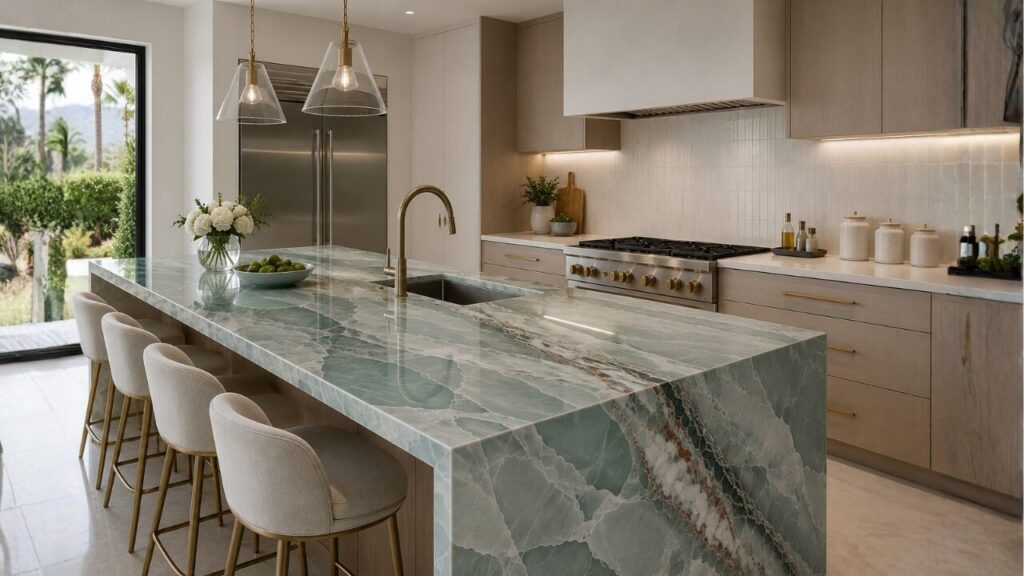
Marbles with strong, linear veining, like Calacatta or Arabescato, tend to bookmatch with the most drama, since the movement is bold enough to read clearly across two mirrored slabs. Quartzite and porcelain with vein-through technology can achieve a similar effect with less maintenance, making them a popular choice for busy kitchens where a homeowner still wants the visual impact of natural stone without the same level of sealing and upkeep. Quartz, by contrast, is manufactured with a repeating pattern rather than natural variation, so while it can still be bookmatched for a coordinated look, it will not produce the same one-of-a-kind mirrored effect that a true natural stone or vein-through porcelain slab can.
The Full-Height Backsplash: Turning a Wall Into a Single Artwork
A full-height marble slab backsplash is one of the clearest ways to showcase bookmatching, since it eliminates the horizontal seam and grout line that would otherwise interrupt the veining partway up the wall. Running the stone from the countertop all the way to the upper cabinets or ceiling lets the pattern flow uninterrupted, which is exactly the kind of continuous surface that makes bookmatched veining read as art rather than material. Many homeowners choose to reserve this treatment for the wall directly behind the range, since it is the kitchen’s natural focal point and the area most people notice first when they walk in.
Waterfall Islands and the Continuous Vein Effect
A waterfall edge kitchen island takes the bookmatching concept and wraps it around a corner, letting the veining appear to fold continuously from the countertop down the side panel to the floor. This requires a precise 45-degree miter cut on both surfaces, joined with a color-matched epoxy so the seam is nearly invisible. When done well, a waterfall island becomes the single most photographed feature in the kitchen, since the eye naturally follows the vein pattern as it turns the corner, an effect that is almost impossible to fake with a standard mitered edge that was not planned with bookmatching in mind.
Where to Spend on Bookmatching and Where to Save
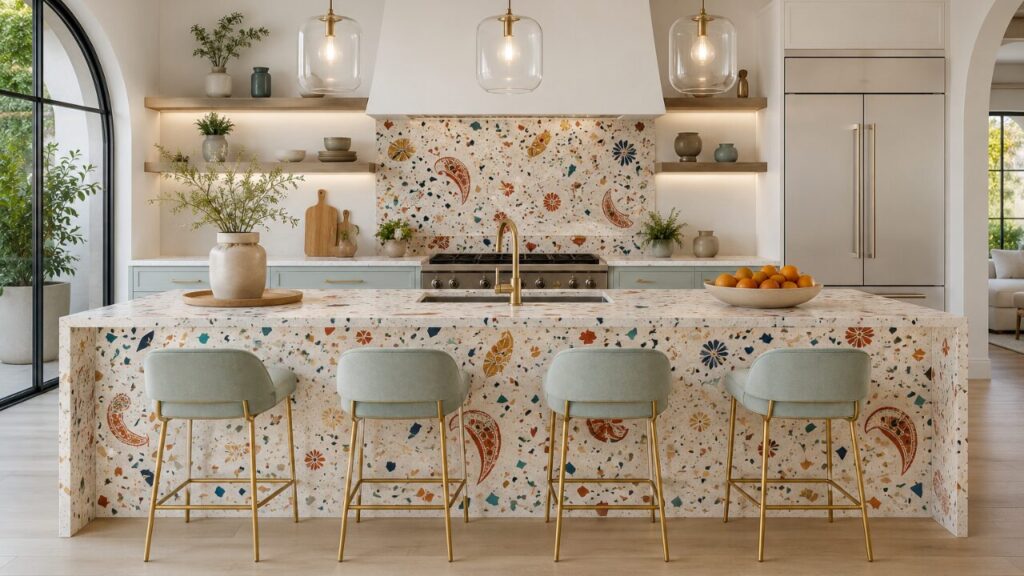
Bookmatching is a material and labor investment, so most homeowners get the best return by concentrating it in one or two high-impact spots rather than spreading it across every surface in the kitchen. A bookmatched island or a full-height backsplash behind the range delivers most of the visual drama on its own, which means perimeter counters, a pantry, or a secondary prep area can often use a simpler, coordinating slab without diminishing the overall design. This approach also keeps the budget focused on the surfaces that will actually be seen and photographed most, rather than treating every square foot of stone in the kitchen as equally important.
Living With a Bookmatched Slab Long Term
A bookmatched installation, once properly supported and sealed where needed, holds up to daily kitchen use just as well as any other natural stone or engineered surface. The bigger long-term consideration is usually availability, since matching a damaged bookmatched slab years later means sourcing from the same or a visually similar block, which is not always possible. For homeowners who want the bookmatched look with more consistency over time, a large format porcelain slab wall with vein-through technology offers a similar visual effect with more predictable, repeatable veining, making future repairs or additions considerably more straightforward.
Frequently Asked Questions
What does it mean for a slab to be bookmatched?
Bookmatching means cutting a stone block into two consecutive slabs and installing them side by side so the veining mirrors itself, similar to opening a book. The pattern on one slab reflects the pattern on the other, creating a symmetrical design that reads as one continuous, intentional piece rather than two separate countertop sections.
Is a full-height slab backsplash worth the extra cost?
A full-height backsplash costs more than a standard four-inch strip because it uses significantly more material, but it also eliminates seams and grout lines while letting the stone’s veining flow uninterrupted from counter to ceiling. Many homeowners manage the cost by using it only behind the range, the kitchen’s natural focal point, and a simpler treatment elsewhere.
Which stones bookmatch best for a dramatic kitchen wall?
Marbles with strong, linear veining, like Calacatta or Arabescato, tend to bookmatch with the most drama, since the movement is bold enough to read clearly across two mirrored slabs. Quartzite and porcelain with vein-through technology can achieve a similar effect with less maintenance, making them a popular choice for busy kitchens.
How do you get a seamless waterfall edge on a kitchen island?
A waterfall edge requires a precise 45-degree miter cut on both the countertop and the side panel, joined with a color-matched epoxy so the seam is nearly invisible. When done well, the veining appears to fold continuously over the edge, which is why waterfall islands are almost always fabricated and installed by an experienced stone professional.
Is bookmatched marble more fragile than a standard slab installation?
Bookmatched installations, especially waterfall edges, do require more careful handling during fabrication and transport, since the mitered joints are more vulnerable to stress than a flat countertop. Once installed correctly on a level, properly supported base, a bookmatched slab is just as durable for daily use as any other natural stone or engineered surface.

Let Your Countertop Tell the Whole Room’s Story
A bookmatched slab is one of the few design choices in a kitchen remodel that functions as both a practical surface and a genuine piece of art. Whether it shows up as a full-height backsplash behind the range or a waterfall island that anchors the whole room, the mirrored veining turns a stone you would otherwise walk past every day into something worth stopping to look at. Our Palm Desert showroom and warehouse stock marble, quartzite, and porcelain slabs selected specifically for their bookmatching potential, and our team can walk you through the layout before a single cut is made.
Browse our slab gallery or contact our team to start planning a bookmatched feature for your kitchen.
Pingback: Waterfall Countertops for Coachella Valley Kitchens